Gamification in Practice: A Reflection on Duolingo as a Gamified Learning Environment


I decided to evaluate the language learning application Duolingo. As someone who took two years of Spanish in high school and left unable to speak it conversationally, the app immediately caught my interest. After all, isn't learning really about being engaged and wanting to learn? In fairness to my old Spanish teacher, it wasn't her fault. At fourteen, I wasn't nearly as ambitious, nor did I have the mindset to realize that consistent effort would eventually pay off. I thought there was no better way to evaluate Duolingo than to see whether it could help me learn Spanish and feel confident speaking it at a basic level.
At its core, Duolingo is designed to help people learn another language. In my experience, Duolingo allows learners to study on their own schedule using a computer, tablet, or phone. As Duolingo co-founder and CEO Luis von Ahn stated, “Our mission is to develop the best education in the world and make it universally available” (von Ahn, 2020). In practice, that mission begins with frequently used, conversational vocabulary that a traveler might need when visiting a country where the language is spoken.
Duolingo offers different starting points based on a learner's existing knowledge, allowing users to begin at a level that matches their proficiency. Because of the limited time available for this assignment, I was only able to evaluate the beginner level. Even so, the app appears designed to meet learners where they are while continuing to challenge them as their proficiency develops.
Analysis of Game Elements
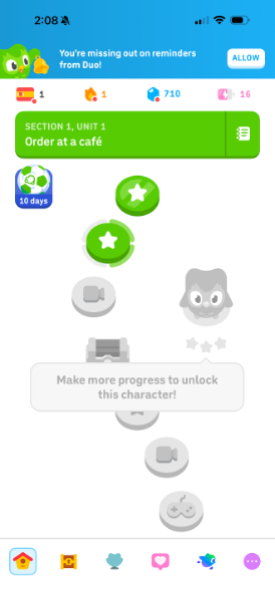
Duolingo's progress structure draws on Kapp's game elements by providing learners with a skill tree, or map, that unlocks new levels through an XP-based point system and even offers a "Legendary" mastery tier for learners seeking an additional level of mastery (Kapp, 2012). Figure 1 shows an example of this map from my own experience, where each unit contains four levels that must be completed before advancing. Progressing through the levels felt motivating because I repeatedly retrieved previously learned vocabulary by matching English words to their Spanish counterparts or vice versa, typing complete sentences, translating phrases, and revisiting the same concepts through various exercises. This repeated retrieval reflects the testing effect, which suggests that recalling previously learned information strengthens long-term retention (Landers et al., 2017).
Figure 1
Duolingo Skill Tree / Progress Map
In addition to the feedback provided after each activity, whether speaking, writing, or matching, the end of each level displayed my total XP earned, the time I spent completing the level, and my overall accuracy. Figure 2 shows this level-completion feedback screen. Personally, I found the immediate feedback after each activity more motivating than the summary at the end of the level. Even so, seeing my overall accuracy still mattered because I naturally strive for 100%. When I answered a question incorrectly, Duolingo did not simply reveal the correct answer. Instead, it immediately presented another opportunity to work through the same concept, often in a different format. Before the level ended, it again revisited the concepts I had missed, giving me additional opportunities to demonstrate understanding rather than simply recognize the correct answer.
Figure 2
Duolingo Level-Completion Feedback Screen

I found the ability to skip ahead gave me a sense of autonomy, allowing me to move further into the material if I felt confident that I already knew it, though I understood that skipping meant forfeiting the XP reward for that level. What initially confused me, however, was the Energy system in the free version, which limits how many levels users can complete before they must wait for their Energy to recharge. As someone using the free version, I found this limitation frustrating because I could not easily determine how the Energy system worked or what options, if any, were available once I reached the limit. If an engaged and motivated learner has to stop and wonder how to continue rather than focus on learning, the system lacks the transparency that clear rules and goals are intended to provide (Kapp, 2012). After exploring the app further, I learned that Super Duolingo removes the usage limitations I encountered in the free version and allows subscribers to continue without advertisements (Krystyna, n.d.). Knowing that made the Energy system feel less like a feature that supported learning and more like a mechanism designed to encourage users to upgrade, regardless of how well they performed.
Connection to Learning Theory
Duolingo's design clearly reflects behaviorist learning principles, particularly through its consistent use of stimulus-response patterns and reinforcement. When a learner selects the correct word, types the correct sentence, translates between English and Spanish, or speaks a word correctly, the application provides immediate positive feedback. When I answered a question incorrectly, Duolingo did not simply reveal the correct answer. Instead, it immediately presented another opportunity to work through the same concept, often in a different format. Before the level ended, it again revisited the concepts I had missed, giving me additional opportunities to demonstrate understanding rather than simply recognize the correct answer.
This immediate right-or-wrong feedback functions as a form of reinforcement. Correct answers are marked in green, accompanied by a positive sound and a pleased expression from one of Duolingo's cartoon characters, while incorrect answers are marked in red, accompanied by a different sound and a disappointed expression. This combination of immediate feedback and reinforcement reflects key principles of behaviorist learning and is widely used in gamified educational environments (Krath et al., 2021). By revisiting concepts answered incorrectly before the level ends and presenting them in different ways, Duolingo provides repeated opportunities to strengthen the correct response.
Based on my experience using Duolingo, behaviorism emerged as the learning theory most clearly reflected in the app's design. Each vocabulary word functions as a stimulus, the learner's answer as the response, and the app's right-or-wrong feedback as the reinforcement. This cycle repeats through matching, Spanish-to-English and English-to-Spanish translation, speaking, and writing activities, strengthening the association between the stimulus and the correct response through repeated practice. Over the weeks I used the app, new vocabulary was introduced gradually rather than all at once. From what I observed, I expect the app will continue building on this foundation by introducing new vocabulary over time rather than presenting large amounts of new material all at once.
Examination of Motivational Theory
Throughout my master’s program, I have learned that the most effective learning experiences incorporate multiple motivational theories rather than relying on a single approach, and Duolingo is no exception. Self-determination theory is evident throughout the app. The ability to skip ahead supports learner autonomy, the sense of accomplishment from answering questions correctly builds competence, and the leaderboard and friend-connection features foster relatedness (Rutledge et al., 2018). Together, these three basic psychological needs—autonomy, competence, and relatedness—help explain why the app feels motivating beyond simply completing tasks.
Goal-setting theory is also reflected in Duolingo's design. The app provides learners with clear, specific goals through its skill-tree map, requiring them to complete a defined set of levels to earn XP and unlock the next unit. This structure aligns with the central principle of goal-setting theory that specific, challenging goals lead to higher performance than vague or ill-defined goals (Locke & Latham, 2002).
I also found myself thinking about flow theory. During my first few sessions with the app, I felt completely immersed. Despite the limited amount of time the free version allows before the Energy restriction takes effect, I lost track of time and found myself wanting to continue. As I continued using the app, however, the repetition necessary for language learning gradually began to wear on my engagement. The experience no longer felt novel; instead, it became familiar and predictable as I continued practicing similar vocabulary through repeated exercise patterns across multiple levels. This suggests that while Duolingo can create a genuine sense of flow early in the learning process, sustaining that state over time becomes more difficult as repeated exercise patterns become less challenging and immersive (Chou, 2026).
Personal Reflection
I found Duolingo genuinely engaging despite the challenge of learning a new language. As I used the app, I often thought back to my two years of high school Spanish and wondered how much more I might have retained if I had access to an application like this at the time. Although the repetition sometimes felt tedious, I came to recognize it as a necessary part of language learning rather than a flaw in the app's design. Without that repetition, I would likely retain little more than I did after high school, where much of the vocabulary faded almost as quickly as I learned it.
What frustrated me most was the time limitation built into the free version. I would have preferred the option to continue using the app for an additional ten to fifteen minutes, even if it meant watching more advertisements, rather than being stopped entirely once my Energy ran out. I understand that the app's business model is designed to encourage users to subscribe, and if I had a more immediate reason to learn Spanish, such as an upcoming trip to a Spanish-speaking country or a professional requirement, I would probably be more willing to pay for it. As a student balancing work and family responsibilities, however, I am not inclined to spend money on an app when I already have other financial priorities.
This time limitation has affected both my motivation and my persistence. Although I still open the app, I do not do so daily, which I recognize may affect my ability to retain new vocabulary, as language learning requires consistent practice. Knowing that each session will end in only a few minutes makes it harder to feel invested in returning regularly.
In terms of accessibility, Duolingo performs reasonably well. Learners have multiple ways to respond, including typing, speaking, and selecting or matching answers, providing flexibility to suit individual preferences or needs. While I do not have a hearing or speech impairment, I recognize that I cannot fully evaluate how accessible the app would be for users who do. From my own experience, my pronunciation was far from perfect, yet the app still marked many of my responses as correct, suggesting that its speech recognition allows for some variation in pronunciation. When spoken Spanish was too fast for me to understand, I could slow the audio or replay it, demonstrating that the designers considered different learning needs. That said, the app's time restrictions and the lack of transparency surrounding the Energy system could still create barriers for some users. For example, someone like my parents, who are less comfortable with technology, might not immediately understand why they could no longer continue or what options are available to them. That added confusion, combined with an already unfamiliar technology, could make the experience more frustrating than motivating and lead them to stop using the app altogether.
Reflecting on this experience, I keep coming back to that ninth-grade classroom where two years of Spanish instruction left me barely able to order food, let alone hold a conversation. What Duolingo made clear to me is that the gap wasn't really about the language itself or even my teacher's methods, but about engagement and consistency—the two things gamification is specifically designed to promote. At fourteen, I didn't have the motivation to practice on my own; vocabulary drills felt like homework rather than a game. Duolingo's structure of immediate feedback, achievable goals, and a clear sense of progress met me where I am now: an adult with far less free time than I had in high school, but far more motivation to learn. For the first time, consistent engagement felt achievable, even in short sessions.
After using Duolingo, I came away with a different view of gamification—one that is more nuanced than simply "making learning fun." It works because it taps into motivational and learning principles, including reinforcement, autonomy, competence, and clear goals. When those elements are designed well, they can sometimes succeed where a traditional classroom falls short. At the same time, my experience with Duolingo's time restrictions showed me that gamification is not a cure-all. When business incentives conflict with learning goals, even a well-designed system can undermine the consistency it depends on for effectiveness.
Design Improvement Recommendation
My primary recommendation for Duolingo would be to reconsider how it monetizes the free version's time restrictions. Rather than stopping learners entirely once their Energy is depleted, I would suggest allowing users to extend their learning time by watching additional advertisements—but not just any advertisements. If I were part of Duolingo's marketing team, I would target travel companies and tourism boards representing countries whose languages are offered on the platform. Instead of advertisements encouraging users to upgrade to a paid subscription, learners could instead see images of beaches in Mexico, historic sites in Spain, or recommendations for local experiences in the country whose language they are learning. This approach would connect the learning experience directly to its real-world application, reinforcing motivation by linking vocabulary practice to a tangible and exciting goal: visiting or engaging with that culture. It could also generate additional revenue for Duolingo through partnerships with the tourism industry, potentially offsetting some subscription revenue while allowing users additional practice time.
Ultimately, my experience with Duolingo reinforced one of the biggest lessons I have taken from this course: effective gamification is not simply about adding game elements to learning. It is about designing experiences that motivate learners, support meaningful engagement, and encourage them to keep coming back. With thoughtful design improvements that better align business goals with learning goals, I believe Duolingo has the potential to become an even stronger educational tool.
References
Chou, Y.-k. (2026, April 2). Flow theory: The complete guide to Csikszentmihalyi's psychology of optimal experience. Yu-kai Chou. https://yukaichou.com/gamification-study/flow-theory/
Kapp, K. M. (2012). The gamification of learning and instruction: Game-based methods and strategies for training and education. Pfeiffer.
Krath, J., Schürmann, L., & von Korflesch, H. F. O. (2021). Revealing the theoretical basis of gamification: A systematic review and analysis of theory in research on gamification, serious games and game-based learning. Computers in Human Behavior, 125, 106963. https://doi.org/10.1016/j.chb.2021.106963
Krystyna. (n.d.). How to get unlimited hearts in Duolingo. Krioda. https://www.krioda.com/how-to-get-unlimited-hearts-in-duolingo/
Landers, R. N., Armstrong, M. B., & Collmus, A. B. (2017). How to use game elements to enhance learning: Applications of the theory of gamified learning. In M. Ma, A. Oikonomou, & L. C. Jain (Eds.), Serious games and edutainment applications (Vol. 2, pp. 457–483). Springer.
Locke, E. A., & Latham, G. P. (2002). Building a practically useful theory of goal setting and task motivation: A 35-year odyssey. American Psychologist, 57(9), 705–717. https://doi.org/10.1037/0003-066X.57.9.705
Rutledge, C., Walsh, C. M., Swinger, N., Auerbach, M., Castro, D., Dewan, M., Khattab, M., Rake, A., Harwayne-Gidansky, I., Raymond, T. T., Maa, T., & Chang, T. P. (2018). Gamification in action: Theoretical and practical considerations for medical educators. Academic Medicine, 93(7), 1014–1020. https://doi.org/10.1097/ACM.0000000000002183
von Ahn, L. (2020, April 15). Duolingo's values: A letter from our CEO. Duolingo Blog. https://blog.duolingo.com/duolingos-values-a-letter-from-the-ceo/


Comments